AI Editing Tools Guide: Features, Editing Functions, Applications and Workflow Considerations
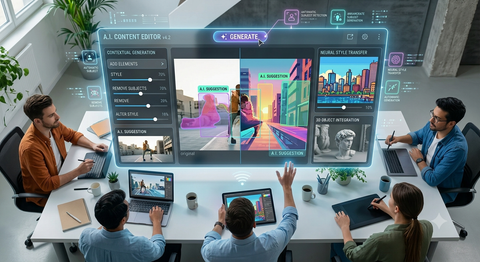
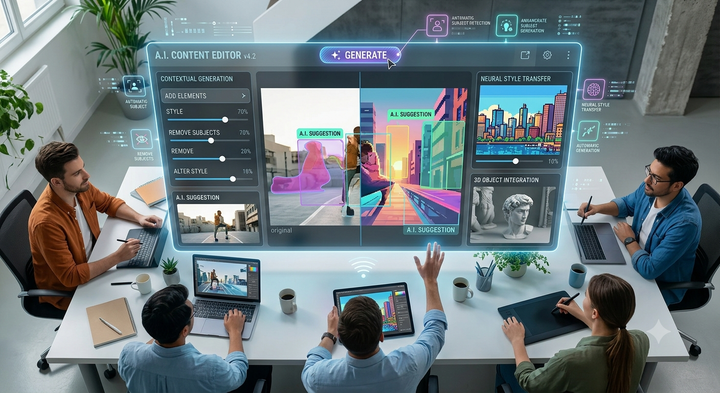
AI editing tools are software applications that use artificial intelligence to assist with changing, organizing, improving, or creating digital content. They can work with images, video, audio, text, documents, and mixed media. The idea comes from combining traditional editing software with machine learning, pattern recognition, speech processing, computer vision, and generative AI. Instead of requiring every adjustment to be performed manually, an AI editing system can identify parts of a file and assist with tasks such as trimming, background removal, transcription, noise reduction, object replacement, caption creation, or layout changes.
How AI editing tools developed
Machine learning introduced functions such as automatic face detection, speech recognition, image enhancement, and scene recognition into conventional editing applications. Generative AI later expanded the workflow by allowing users to describe some changes using ordinary language.
An AI editing tool may combine several technologies rather than relying on one model. A photo editor can recognize objects, a video editor can identify spoken words, and an audio editor can separate or reduce unwanted sounds. These functions are designed to assist human editing rather than remove the need for review.
What the tools can edit
AI editing tools are now used across several media types. Common examples include:
- Images: object removal, background changes, image expansion, restoration, resizing, and visual adjustments.
- Video: clip selection, transcription, scene refinement, caption creation, background changes, and generated extensions.
- Audio: speech enhancement, silence detection, transcription, noise reduction, and voice-related editing.
- Text: grammar correction, rewriting, summarization, formatting, and document organization.
- Mixed media: combining text, images, narration, video clips, captions, and music within one workflow.
Functions differ by platform and file type, and results vary with source material, instructions, language, and human review.
Importance
Why AI editing tools matter
Digital content is created in many everyday settings, including education, personal projects, journalism, business communication, social media, and video production. Editing can involve repetitive actions such as finding pauses, sorting clips, correcting small visual problems, creating captions, or preparing different aspect ratios. AI can assist with these steps by identifying patterns and suggesting changes.
Human review remains important
AI-assisted edits can contain errors. An object may be changed incorrectly, a transcript may mishear a word, or an automatically selected video segment may miss important context. Generated images and audio can also introduce details that were not present in the original material.
Users can check factual details, faces, names, numbers, captions, visual continuity, audio quality, and rights associated with source material before publishing or sharing an edited file.
Common applications
AI editing tools can support educational content, personal media, publishing, professional presentations, interviews, tutorials, captions, transcripts, and other accessibility-related tasks.
Recent Updates
Generative editing has become more interactive
From 2024 through 2026, AI editing has moved from isolated automatic adjustments toward more interactive workflows. Google introduced AI media experiments that included video generation and image editing, while later tools such as Flow combined generation and refinement within a broader creative workflow. Google also expanded AI-assisted editing in YouTube Create, including automatic first drafts from camera footage and editing assistance in English and Hindi.
Video editing has also gained more direct prompt-based controls. Adobe Firefly's AI video editor supports prompt-based changes, clip trimming, rearrangement, generated footage, titles, voiceover, and audio adjustments. Adobe Premiere has added functions such as Generative Extend, Object Mask, text-based editing, and AI-assisted media search.
More control over generated media
A noticeable trend is the move toward editing existing content instead of only generating content from a blank prompt. Recent Google Flow updates describe tools for inserting or removing objects, changing images, adjusting camera movement, and managing generated assets in one workspace. This reflects a broader shift toward combining manual editing with AI-assisted changes.
Another development is clearer identification of AI-created media. YouTube has described the use of SynthID watermarks and content labels for certain AI creations, while identity-protection features such as likeness detection are being developed for creators. These measures address questions about authenticity, attribution, and unauthorized use.
Feature comparison
| Editing area | Common AI function | Human review point |
|---|---|---|
| Images | Object removal or background editing | Check edges, lighting, and altered details |
| Video | Clip selection or generated extension | Check continuity and scene meaning |
| Audio | Noise reduction or transcription | Check names, words, and sound quality |
| Text | Rewriting or summarization | Verify facts and intended meaning |
| Captions | Automatic speech-to-text | Correct names, numbers, and technical terms |
Laws or Policies
India as the reference jurisdiction
For this policy overview, India is used as the reference jurisdiction. AI editing can involve personal data, copyrighted material, recorded voices, photographs, and synthetic media, so several areas of Indian law may become relevant depending on how a tool is used.
Data protection
India's Digital Personal Data Protection Act, 2023 provides a framework for processing digital personal data, while the Digital Personal Data Protection Rules, 2025 establish implementation details and a phased commencement schedule. The rules were notified in November 2025, with different provisions taking effect at different stages.
For AI editing, this matters when users upload identifiable photographs, recordings, documents, or other personal information to an editing platform. Appropriate handling depends on the type of data, the purpose of processing, the organization involved, and the applicable provisions.
Copyright and edited material
India's Copyright Act, 1957 protects original literary, dramatic, musical, and artistic works, as well as cinematograph films and sound recordings. The Copyright Office also explains that copyright generally protects original expression rather than an idea itself.
AI editing can create copyright questions when a user modifies photographs, music, video, written material, or other protected works. The legal position can depend on authorship, source material, permissions, the nature of the changes, and the way the resulting work is used. The Act also contains specific provisions concerning computer-generated works, so individual situations may require careful legal interpretation.
Synthetic media and platform rules
India has also been developing policy responses to synthetic media and deepfakes. In 2025, the Ministry of Electronics and Information Technology published proposed amendments to the Information Technology Rules concerning synthetically generated information. The explanatory material described concerns involving realistic synthetic audio, visual, and audio-visual material, including risks related to deception, impersonation, privacy, and misinformation.
Tools and Resources
Editing platforms and learning resources
Different tools focus on different parts of the editing process. Adobe Firefly and Premiere provide AI-assisted image and video editing functions, while Google Flow focuses on AI-assisted image and video creation and refinement. YouTube Create includes AI-assisted editing features for mobile-oriented video workflows.
Useful resources can also include:
- Official product documentation: Helps explain supported formats, editing functions, privacy terms, and usage limits.
- Copyright Office resources: Useful for understanding India's copyright framework and basic rights.
- MeitY publications: Useful for checking current Indian data-protection and technology-policy information.
- Editing templates: Can help organize repeated video, presentation, or document structures.
- Transcription tools: Useful for turning recorded speech into searchable text before editing.
- Metadata and file information tools: Help users inspect formats, dimensions, timestamps, and other technical details.
A practical AI editing workflow
A simple workflow can be organized into five stages. First, collect and review the original files. Second, identify which repetitive tasks can be assisted by AI. Third, generate or apply the edits while keeping the original files available. Fourth, review the output manually for accuracy, continuity, privacy, and copyright concerns. Finally, export the required format and keep a clear record of significant edits when documentation is important.
This approach separates source material from generated changes and makes it easier to correct an AI-generated mistake without losing the original version.
FAQs
What are AI editing tools used for?
AI editing tools are used to assist with image, video, audio, and text editing. Common functions include transcription, object removal, background changes, noise reduction, caption creation, clip selection, and text-based editing.
How do AI editing tools improve an editing workflow?
AI editing tools can identify repetitive tasks and assist with them through automated analysis or natural-language instructions. Examples include finding sections of a video through a transcript, removing pauses, or selecting an object for editing.
Are AI editing tools accurate?
Accuracy varies by tool, source material, language, and editing task. Users should review transcripts, generated visuals, audio changes, and factual content before treating an AI-assisted result as final.
What should I check when using AI editing tools?
Check the tool's privacy terms, supported formats, handling of uploaded material, copyright implications, and any rules concerning synthetic or altered media. Also keep an original copy of important files.
Are AI-edited images and videos covered by copyright in India?
Copyright can apply to original protected material, but AI-assisted creation can raise questions about authorship, source material, originality, and the nature of the human contribution. India's Copyright Act, 1957 contains rules for protected works and computer-generated works, so the circumstances matter.
Conclusion
AI editing tools combine traditional editing methods with machine learning and generative AI to assist with images, video, audio, text, and mixed media. Recent developments have moved toward prompt-based editing, integrated workflows, generated extensions, automated first drafts, and clearer identification of AI-created media. In India, data protection, copyright, privacy, and synthetic-media rules can all be relevant depending on how edited material is created and used. Human review remains important for checking accuracy, context, rights, and the final appearance of AI-assisted content.