Hydraulic Press Explained: Types, Components, Working Principles, Applications and Benefits
A hydraulic press is an industrial machine that uses pressurized fluid to generate force for shaping, compressing, forming, or assembling materials. Hydraulic press systems are widely used in manufacturing, metalworking, automotive production, recycling, and other industrial activities. Their working principles are based on fluid pressure, which allows a relatively small input force to produce a much larger output force under suitable conditions.
Context
A hydraulic press is an industrial machine that uses pressurized fluid to generate force for shaping, compressing, forming, or assembling materials. Hydraulic press systems are widely used in manufacturing, metalworking, automotive production, recycling, and other industrial activities. Their working principles are based on fluid pressure, which allows a relatively small input force to produce a much larger output force under suitable conditions.
The development of hydraulic machinery is closely connected to Pascal's principle, which describes how pressure applied to a confined fluid is transmitted throughout that fluid. This principle became an important foundation for hydraulic equipment during the development of industrial machinery. Over time, hydraulic presses evolved from relatively simple mechanical arrangements into systems with electric pumps, electronic controls, pressure sensors, and automated operating cycles.
What Is a Hydraulic Press?
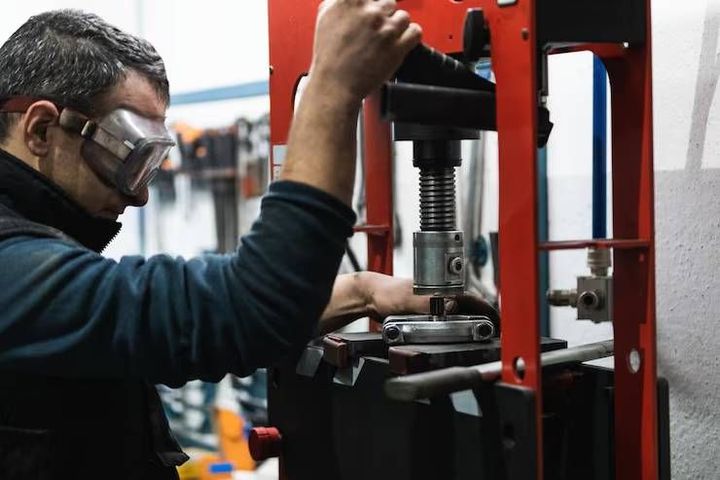
A hydraulic press typically consists of a frame, hydraulic cylinder, piston, pump, reservoir, valves, and control equipment. The pump moves hydraulic fluid through the system, while valves regulate its direction and pressure. The pressurized fluid acts on a piston, creating the force required to move a pressing tool or platen.
Hydraulic presses are available in different sizes and configurations. Small workshop models can handle basic pressing and assembly tasks, while large industrial systems can form substantial metal components. The appropriate machine depends on the material, required force, working area, production speed, and nature of the operation.
Hydraulic Press Working Principle
The hydraulic press working principle follows Pascal's principle. When pressure is applied to a confined fluid, that pressure is transmitted through the fluid to the surfaces in contact with it.
The relationship between force, pressure, and piston area can be expressed as:
Pressure = Force ÷ Area
If pressure acts on a larger output piston, the resulting force can be greater than the input force applied to a smaller piston. However, force multiplication does not create additional energy. In an ideal system, the larger piston moves a shorter distance, while real machines also experience losses caused by friction, fluid flow, and mechanical resistance.
For example, a system that develops 10 megapascals of pressure across a piston area of 0.01 square metres produces an ideal force of 100,000 newtons. The actual force available at the working tool depends on the machine's design, operating conditions, and efficiency.
Importance
Hydraulic presses are important because many manufacturing processes require controlled and substantial force. These machines help shape sheet metal, compress materials, fit components together, form industrial parts, and reduce the volume of certain recyclable materials. Their ability to apply force through a controlled movement makes them useful in production environments that require repeatable operations.
Hydraulic press technology affects manufacturers, maintenance technicians, metalworkers, vehicle producers, recycling facilities, and engineering workshops. The equipment also supports the production of everyday items, including automotive components, metal enclosures, electrical parts, and molded products.
Main Components of a Hydraulic Press
Each component performs a specific role in generating and controlling pressing force.
Frame: Supports the machine and withstands the loads produced during operation.
Hydraulic cylinder: Converts fluid pressure into linear movement.
Piston and ram: Move under hydraulic pressure and apply force to the workpiece or tooling.
Hydraulic pump: Circulates fluid through the system.
Fluid reservoir: Stores the hydraulic fluid required for operation.
Control valves: Direct fluid flow and regulate pressure or movement.
Hydraulic hoses and pipes: Carry fluid between system components.
Pressure gauge and sensors: Indicate or measure operating pressure and related conditions.
Control panel: Allows an operator to select operating modes and monitor the machine.
The condition of these components affects machine performance and safety. Fluid leaks, worn seals, damaged hoses, incorrect pressure settings, or faulty controls can interfere with normal operation.
Types of Hydraulic Presses
Different hydraulic press designs serve different purposes. Their frame structure, cylinder arrangement, working capacity, and control systems influence which operations they can perform.
H-frame press: Uses a rigid frame resembling the letter H. It is commonly found in workshops and maintenance areas.
C-frame press: Provides open access from three sides, making it useful for certain assembly and forming tasks.
Four-column press: Uses four supporting columns to guide the moving platen and support larger working areas.
Hydraulic forging press: Applies substantial compressive force to shape heated or otherwise suitable metal stock.
Deep drawing press: Forms sheet metal into hollow shapes such as containers and selected automotive components.
Laminating press: Applies controlled pressure to bond layers of compatible materials.
Baling press: Compresses materials such as cardboard, paper, or certain recyclable metals into manageable bundles.
These categories may overlap in practice. A machine's intended application, tooling, operating range, and safety equipment are as important as its general frame type.
Hydraulic Press Applications
Hydraulic presses are used across several industrial sectors because their force and movement can be adapted to different production tasks.
| Industry | Typical application | Purpose |
|---|---|---|
| Automotive | Component forming and bearing installation | Shape or assemble parts |
| Metalworking | Bending, punching, and forming | Change metal geometry |
| Manufacturing | Press fitting and compression molding | Join or form components |
| Recycling | Baling selected waste materials | Reduce material volume |
| Aerospace | Forming suitable metal components | Produce shaped parts |
| Woodworking | Laminating panels | Bond compatible layers |
| Laboratory research | Controlled material compression | Examine material behaviour |
Not every hydraulic press is suitable for every application. Tooling, force capacity, stroke length, temperature requirements, and workpiece dimensions must match the operation.
Recent Updates
Hydraulic press technology continues to develop through improvements in automation, energy management, sensing, and machine monitoring. During 2024–2026, general industrial trends have included greater integration of electronic controls, condition monitoring, programmable operating sequences, and variable-speed hydraulic systems. The extent of adoption differs by industry, equipment size, and production requirements.
Automation and Digital Controls
Modern hydraulic presses may use programmable logic controllers, electronic pressure sensors, position sensors, and operator interfaces to manage pressing cycles. These systems can regulate movement, monitor operating conditions, record process information, and help maintain consistency between production cycles.
Some installations connect press data to factory monitoring systems. Such integration can help operators identify unusual pressure patterns, extended cycle times, or potential maintenance requirements. However, monitoring systems do not eliminate the need for physical inspections, appropriate guarding, and trained personnel.
Energy Efficiency and Predictive Maintenance
Traditional hydraulic systems may continue running pumps even when the machine requires little or no movement. Some newer designs use variable-speed drives, demand-based pump control, or other arrangements to adjust energy use to operating needs. Actual energy consumption depends on machine design, load, duty cycle, and maintenance condition.
Predictive maintenance approaches use information such as fluid temperature, pressure, vibration, and operating hours to help identify developing faults. Correct fluid selection, filtration, seal inspection, and leak detection remain important regardless of whether digital monitoring is installed.
Laws or Policies
Hydraulic press operation is influenced by workplace safety regulations, machinery standards, electrical requirements, environmental rules, and the manufacturer's operating instructions. Applicable requirements vary according to the country, workplace, machine configuration, and activity being performed.
Industrial Safety Requirements in India
In India, industrial workplaces may be subject to applicable occupational safety and health legislation, including the Occupational Safety, Health and Working Conditions Code, 2020, and relevant rules or implementation provisions in force. The precise requirements depend on the establishment, applicable legal framework, and commencement or transitional arrangements.
Hydraulic press installations may also need to comply with relevant machinery, electrical, and workplace safety requirements. Employers and operators must consider suitable guarding, emergency stopping arrangements, operator training, maintenance procedures, and safe methods for clearing jams or changing tooling.
Machine Standards and Operator Protection
International and Indian technical standards can provide guidance on press design, hydraulic system safety, risk assessment, and protective equipment. The relevant standard depends on the type of press and the application. Compliance should be assessed against the standards and regulations applicable to the specific installation rather than assumed from the machine's appearance.
Important safety measures may include:
Fixed guards or interlocked protective devices around hazardous areas.
Suitable two-hand controls or other protective systems where required by the risk assessment.
Emergency stopping arrangements appropriate to the machine.
Isolation of electrical and hydraulic energy before maintenance.
Inspection of hoses, cylinders, valves, and pressure-relief equipment.
Clear operating procedures and training for authorized personnel.
Hydraulic pressure can remain trapped even after a pump stops. Maintenance therefore requires suitable energy-isolation and pressure-release procedures established by qualified personnel.
Tools and Resources
Hydraulic press calculations, technical documentation, and inspection records help engineers and operators understand machine capacity and operating conditions. The tools selected should match the press design and the level of technical knowledge required.
Hydraulic Press Force Calculators
A hydraulic press force calculator estimates output force from fluid pressure and piston area. The basic relationship is:
Output force = Pressure × Piston area
For a circular piston, its area is calculated using the piston diameter:
Piston area = π × (Diameter ÷ 2)²
Pressure units and area units must be consistent. For example, pressure in pascals multiplied by area in square metres gives force in newtons. These calculations represent ideal force and do not replace the machine's rated capacity or engineering assessment.
Technical Manuals and Reference Resources
Several resources can help explain hydraulic press systems and their operating requirements:
Manufacturer manuals: Provide machine-specific capacity limits, hydraulic diagrams, maintenance schedules, and operating instructions.
Hydraulic component catalogues: Explain pump, valve, cylinder, seal, and filtration specifications.
Engineering reference materials: Describe fluid mechanics, force calculations, and hydraulic circuit design.
Bureau of Indian Standards: Provides information about relevant Indian technical standards.
International Organization for Standardization: Publishes international standards covering machinery safety and related engineering topics.
Maintenance checklists: Record fluid levels, leakage, unusual noises, safety-device condition, and inspection findings.
Technical documents should be matched to the exact equipment model and application. General calculators and reference guides cannot establish whether a particular machine is safe to operate.
FAQs
How does a hydraulic press work?
A hydraulic press uses pressurized fluid to move a piston and generate force. Pressure applied to the fluid acts on the piston area, producing the force used to compress, shape, or assemble a workpiece.
What are the main types of hydraulic presses?
Common types include H-frame, C-frame, four-column, forging, deep drawing, laminating, and baling presses. Each design supports different working arrangements and industrial applications.
What are the main components of a hydraulic press?
The main components include the frame, hydraulic cylinder, piston, pump, reservoir, valves, hoses, pressure sensors, and controls. Together, they generate, direct, and regulate hydraulic force.
What is a hydraulic press used for in manufacturing?
Hydraulic presses are used for metal forming, compression molding, component assembly, forging, laminating, and recycling operations. The specific use depends on the machine's rated capacity and tooling.
What safety precautions are important when operating a hydraulic press?
Operators should use suitable guards, follow approved procedures, inspect the equipment, and keep hands away from hazardous moving parts. Before maintenance, electrical and hydraulic energy must be isolated and trapped pressure safely released.
Conclusion
A hydraulic press uses fluid pressure to generate controlled force for industrial forming, compression, and assembly tasks. Its design includes components such as cylinders, pumps, valves, and control systems, which work together to perform different operations. Automation, monitoring, and energy-management technologies continue to influence modern hydraulic equipment. Understanding machine capacity, maintenance requirements, and applicable safety regulations is essential to understanding hydraulic press operation.