Before forklifts became widely used, industries relied heavily on manual labor and basic mechanical devices such as pulleys or carts. As manufacturing expanded in the early 20th century, businesses required faster and safer ways to move heavy goods. This need led to the development of forklifts, which combine lifting mechanisms with motorized mobility.
A typical forklift consists of several key components:
| Component | Function |
|---|
| Mast | Vertical assembly used for lifting loads |
| Forks | Metal prongs that support pallets |
| Counterweight | Balances heavy loads during lifting |
| Overhead Guard | Protects the operator from falling objects |
| Hydraulic System | Enables lifting and lowering movement |
Modern forklifts can lift loads ranging from small pallet shipments to several tons of industrial materials.
Types of Forklifts Used in Industry
Different industries require different forklift designs depending on the workspace and materials handled.
| Forklift Type | Common Usage |
|---|
| Counterbalance Forklift | Standard warehouse operations |
| Reach Truck | High-rack warehouse storage |
| Pallet Jack | Short distance pallet transport |
| Rough Terrain Forklift | Construction sites |
| Order Picker | Distribution centers and e-commerce warehouses |
Each forklift type is designed to improve operational efficiency in specific environments.
Why Forklifts Matter in Modern Logistics
Role in Supply Chains and Warehousing
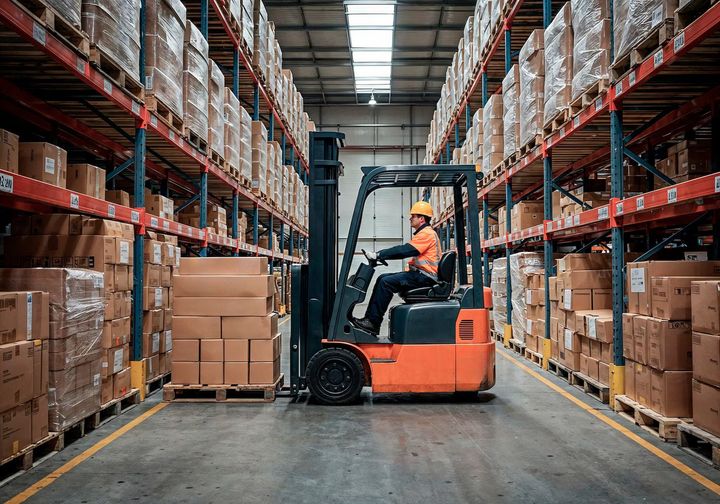
Forklifts are fundamental to modern logistics infrastructure. Global supply chains rely on efficient warehouse operations, where forklifts are used to move goods between storage locations, loading docks, and transportation vehicles.
Industries that depend heavily on forklifts include:
-
Manufacturing plants
-
Retail distribution centers
-
Shipping and logistics companies
-
Construction and infrastructure projects
-
Agricultural storage facilities
Without forklifts, these sectors would experience slower operations, higher labor requirements, and increased safety risks.
Productivity Improvements in Warehouse Operations
Forklifts significantly increase productivity by allowing fewer workers to move heavier loads faster. A single forklift operator can handle materials that would otherwise require several workers.
The following table illustrates how forklifts influence operational efficiency:
| Warehouse Task | Manual Handling | Forklift Handling |
|---|
| Pallet Movement | Slow and labor intensive | Fast and controlled |
| High Shelf Storage | Limited by human reach | Efficient vertical stacking |
| Loading Trucks | Multiple workers required | Single operator operation |
| Large Load Transport | Difficult and unsafe | Stable and precise |
These improvements contribute to smoother inventory management and faster order fulfillment.
Recent Developments in Forklift Technology
Growth of Electric Forklifts
In recent years, electric forklifts have gained popularity due to environmental awareness and advances in battery technology.
Between 2023 and 2025, several manufacturers introduced lithium-ion battery forklifts designed for longer operating hours and faster charging cycles. These electric models reduce emissions and noise levels, making them suitable for indoor warehouse environments.
Advantages of electric forklifts include:
-
Lower emissions
-
Reduced noise levels
-
Smooth acceleration and operation
-
Lower maintenance compared with internal combustion engines
Automation and Smart Warehousing
Automation trends have also influenced forklift technology. Many warehouses now use semi-autonomous or guided forklift systems integrated with warehouse management software.
Key innovations include:
-
Autonomous mobile forklifts
-
AI-driven warehouse routing systems
-
Collision detection sensors
-
Fleet monitoring platforms
These technologies help warehouse managers track equipment usage, improve safety, and optimize material movement.
Global Market Growth
Industry research published in 2024 logistics reports indicates increasing global demand for forklifts due to expansion in e-commerce and warehouse automation. Distribution centers supporting online retail require efficient pallet handling equipment to manage large inventory volumes.
Regulations and Safety Policies for Forklift Operations
Workplace Safety Standards
Forklift operation is regulated in many countries to ensure workplace safety. Governments and occupational safety agencies require training programs and operational guidelines for forklift operators.
Common regulatory requirements include:
-
Certified operator training
-
Equipment inspection schedules
-
Load capacity limits
-
Safety signage and designated operating zones
These rules help reduce accidents involving heavy machinery in warehouses and construction environments.
Industrial Safety Guidelines
Workplace safety authorities typically recommend the following forklift practices:
-
Always maintain stable loads during lifting
-
Keep forks low when traveling without a load
-
Avoid sharp turns with elevated materials
-
Ensure clear visibility while driving
Employers must also provide protective infrastructure such as pedestrian lanes and warning signals.
Environmental and Emissions Policies
Environmental regulations are encouraging industries to transition toward electric forklifts. Many regions have introduced sustainability initiatives promoting low-emission industrial equipment.
For example, several international manufacturing policies introduced between 2023 and 2024 encourage the adoption of energy-efficient warehouse vehicles and electrified logistics systems.
Useful Tools and Resources for Forklift Operations
Digital Tools for Warehouse Management
Modern warehouses rely on digital tools to coordinate forklift operations and inventory management.
Some commonly used platforms include:
| Tool | Purpose |
|---|
| Warehouse Management Systems (WMS) | Inventory tracking and warehouse coordination |
| Fleet Monitoring Software | Tracks forklift usage and maintenance schedules |
| Safety Training Platforms | Online forklift operator training programs |
| Equipment Inspection Apps | Digital safety inspection checklists |
These tools help organizations improve efficiency and maintain regulatory compliance.
Online Calculators and Planning Resources
Several digital resources help warehouse planners determine the appropriate forklift capacity and storage layout.
Examples include:
-
Load capacity calculators
-
Warehouse layout planners
-
Logistics optimization software
-
Safety risk assessment templates
These tools help companies plan storage systems while ensuring safe forklift operations.
Industry Information Resources
Professionals interested in learning more about forklifts can explore:
-
Manufacturing industry publications
-
logistics research reports
-
industrial equipment manuals
-
warehouse safety training materials
These resources provide detailed technical insights into equipment design and operational practices.
Frequently Asked Questions About Forklifts
What is the main purpose of a forklift?
A forklift is designed to lift and transport heavy materials over short distances. It is commonly used in warehouses, factories, and logistics centers to move palletized goods safely and efficiently.
How much weight can forklifts typically lift?
Forklift lifting capacity varies depending on the model. Many standard forklifts handle loads between 1,500 kg and 5,000 kg, while specialized industrial models can lift significantly heavier materials.
Are forklifts used only in warehouses?
No. Although warehouses use forklifts extensively, they are also used in construction sites, shipping ports, agricultural storage facilities, and manufacturing plants.
What types of energy sources power forklifts?
Forklifts may operate using different power sources including:
-
Electric battery systems
-
Diesel engines
-
Liquefied petroleum gas (LPG)
-
Propane fuel systems
Electric forklifts are becoming increasingly common due to environmental considerations.
Why is forklift training important?
Forklift training helps operators understand safe driving techniques, load handling procedures, and equipment maintenance requirements. Proper training reduces workplace accidents and improves operational efficiency.
Conclusion
Forklifts have become essential equipment in modern industrial operations. From warehouse storage systems to construction sites, these machines enable workers to move heavy materials quickly and safely.
As global supply chains continue expanding, forklifts will remain a critical component of logistics infrastructure. Advances in electric power systems, automation technology, and digital fleet management tools are shaping the future of material handling.
Organizations that implement proper safety training, follow regulatory guidelines, and adopt modern warehouse technologies can maximize the benefits of forklift operations. Understanding forklift types, operational practices, and emerging trends helps businesses maintain efficient, safe, and sustainable material handling systems.