AI Email Marketing Automation Guide: Campaign Types, Automation Workflows, Features and Uses
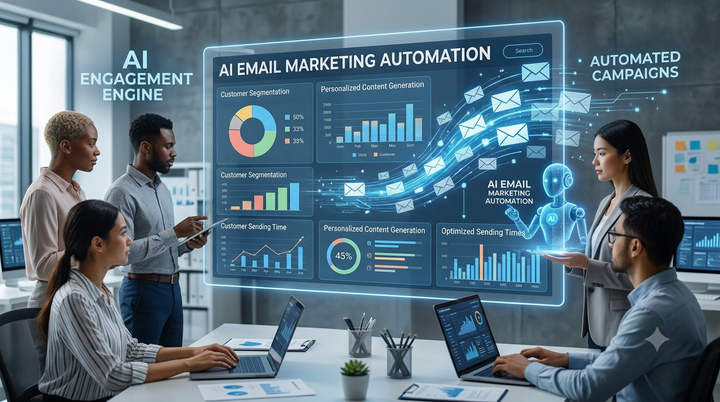
AI email marketing automation combines email communication, automated workflows, and artificial intelligence to organize how messages are created, scheduled, personalized, and delivered. Instead of treating every recipient in the same way, an automated system can use information such as signup activity, previous interactions, content interests, or email engagement to determine which message should be sent next.
Email automation developed from simple scheduled newsletters and rule-based campaigns. Earlier systems mainly followed fixed instructions, such as sending a welcome message after someone joined a mailing list. Modern AI email marketing automation can add language generation, audience grouping, content suggestions, send-time analysis, behavioral triggers, and workflow recommendations.
The basic process usually involves four parts: collecting permission-based contact information, defining audience groups, creating an automation workflow, and measuring responses. AI can assist with some of these activities, but the underlying rules and data still need to be clearly defined.
Common campaign types
AI email marketing automation can support several campaign formats. A newsletter can distribute educational updates to a defined audience, while a welcome sequence introduces information after a person subscribes. Other formats include event reminders, educational series, product updates, re-engagement messages, and follow-up sequences.
| Campaign type | Typical trigger | Main purpose |
|---|---|---|
| Welcome sequence | New subscription | Introduce information and expectations |
| Educational series | Signup or selected interest | Provide information over several messages |
| Reminder campaign | Upcoming event or deadline | Communicate relevant timing |
| Re-engagement sequence | Reduced interaction | Check whether continued communication is wanted |
| Follow-up workflow | Previous interaction | Continue a defined communication sequence |
| Newsletter | Scheduled interval | Share recurring information |
The exact campaign structure depends on the audience, communication purpose, consent status, and available data.
Importance
Email remains a structured way to distribute information because messages can be organized around specific topics, events, or user actions. Automation matters when the same communication process contains repeated steps that would otherwise require manual scheduling.
AI email marketing automation can address several practical challenges. A large contact list may contain people with different interests, activity levels, and communication preferences. Sending identical messages to everyone may not reflect those differences, while manually creating separate workflows can become difficult as the audience grows.
How automation workflows work
An automation workflow is a sequence of conditions and actions. A person might enter a workflow after subscribing to an information list. The system can then wait for a defined period, send a message, check whether the message was opened or another permitted interaction occurred, and continue according to the configured rules.
Common workflow components include:
- Trigger: The event that starts the workflow.
- Condition: A rule that determines which path should be followed.
- Action: An email, delay, audience update, or other configured event.
- Branch: Different paths based on defined conditions.
- Exit rule: A condition that removes someone from the sequence.
AI can assist with message drafting, subject-line variations, audience grouping, content recommendations, and analysis of campaign patterns. Human review remains important because automatically generated text can contain errors, inappropriate assumptions, or information that does not match the intended audience.
Features and uses
Common AI email marketing automation features include content generation, audience segmentation, behavioral triggers, personalization fields, workflow builders, analytics dashboards, and testing tools.
Personalization can range from simple details, such as a recipient's name, to content based on previously selected interests. More advanced systems may use behavioral information to determine which message variation is appropriate. Such processing should be based on an appropriate legal basis and clearly communicated data practices.
Automation can also be used for internal communication, educational newsletters, event information, onboarding sequences, and recurring informational updates. The purpose of the workflow should remain clear so that recipients understand why they are receiving the communication.
Recent Updates
From 2024 through 2026, AI email marketing automation has increasingly incorporated generative AI into existing campaign tools. Rather than functioning only as a rule-based scheduler, an automation platform may now assist with drafting email text, summarizing audience activity, suggesting content variations, organizing segments, and analyzing campaign results.
Another noticeable development is the connection between AI tools and broader customer-data systems. Email platforms can increasingly work with website activity, forms, customer records, analytics information, and other permitted data sources. This creates more opportunities for contextual communication but also increases the importance of accurate data handling.
AI-assisted content creation has also increased the need for human review. Generated text can sound appropriate while still containing inaccurate facts, unsuitable wording, or unintended personalization. Organizations therefore need defined review processes when AI is used to prepare or modify email content.
Privacy and consent have also become more prominent. India's Digital Personal Data Protection Rules, 2025 were notified with a phased implementation timeline, adding greater detail around notices, consent, and handling of personal data.
Another trend is greater attention to automated decision-making and profiling. In jurisdictions such as the European Union, data-protection rules place conditions on certain forms of solely automated decisions and provide rights related to profiling and direct marketing.
Laws or Policies
For readers and organizations operating in India, email automation involving personal data should be considered alongside India's Digital Personal Data Protection Act, 2023 and the Digital Personal Data Protection Rules, 2025. The framework addresses how digital personal data is collected and processed and includes requirements concerning notice, consent, and withdrawal of consent. The Rules were notified in 2025 with different provisions taking effect according to a phased timeline.
A clear consent process is important when consent is the basis for processing personal data. The framework describes consent in terms of a clear, informed, specific, and affirmative indication, and provides for withdrawal where consent is the applicable basis.
India also has the Telecom Commercial Communications Customer Preference Regulation framework administered by TRAI. It primarily addresses commercial communications through telecom channels such as messages and calls rather than functioning as a general email-marketing law. The framework includes mechanisms involving registered senders, consent, and recipient preferences.
Organizations communicating internationally may also need to consider the laws of the recipient's jurisdiction. For example, European data-protection rules recognize a person's right to object to direct marketing and require appropriate handling of consent and personal-data processing.
Because requirements can depend on the type of data, communication, audience, and jurisdiction, this information is general knowledge rather than legal advice.
Tools and Resources
Several types of tools can support AI email marketing automation workflows. The appropriate tool depends on the communication purpose, audience size, data structure, integrations, and required automation features.
Email automation platforms
Platforms such as Mailchimp, HubSpot, ActiveCampaign, and Brevo provide combinations of email creation, audience management, automation workflows, analytics, and AI-assisted features. Their specific functions, data practices, and available plans can change over time.
Planning and workflow resources
A simple workflow template can help map each automation before it is configured. A useful planning document can contain:
- Audience or segment
- Trigger event
- Message purpose
- Waiting period
- Condition or branch
- Exit condition
- Data used for personalization
- Measurement method
Analytics dashboards can then be used to review delivery, opens, clicks, unsubscribes, and other available measurements. These figures should be interpreted in context because email metrics can be affected by privacy controls, device settings, mailbox filtering, and tracking limitations.
FAQs
What is AI email marketing automation?
AI email marketing automation uses artificial intelligence together with automated email workflows to help organize communication. It can assist with content creation, audience segmentation, personalization, timing, and campaign analysis while following predefined rules.
How do AI email marketing automation workflows work?
An automation workflow normally begins with a trigger, such as a subscription or permitted interaction. The system then follows configured conditions, delays, messages, and branches until an exit condition is reached.
What are common AI email marketing campaign types?
Common types include welcome sequences, newsletters, educational campaigns, reminders, follow-up workflows, and re-engagement sequences. The appropriate format depends on the communication purpose and recipient preferences.
What features are included in AI email marketing automation?
Common features include AI-assisted writing, segmentation, personalization, workflow builders, behavioral triggers, testing, analytics, and reporting. Availability differs between platforms.
Does email automation require consent?
Consent requirements depend on the applicable law, communication purpose, and legal basis for processing personal data. In India, the Digital Personal Data Protection framework includes rules concerning notice, consent, and withdrawal where consent is the applicable basis.
Conclusion
AI email marketing automation combines artificial intelligence with structured email workflows to organize recurring communication. Its applications include campaign sequencing, personalization, audience segmentation, content assistance, and performance analysis. Recent developments have increased the role of generative AI and data-driven automation while also placing greater attention on privacy and consent. Effective use depends on accurate data, clearly defined workflows, appropriate human review, and compliance with applicable communication and data-protection rules.